
Let There Be Light
It’s summer in the UK - hooray!! We can finally leave the house without our rain jacket, well on some days at least. The temperature is up, the natural world is buzzing with activity, the nights are short and the days are long. What a great time to be a landscape photographer. And it is…..well kinda!
You see, it’s that ‘the days are long’ bit, that can cause some issues for landscape photographers…..

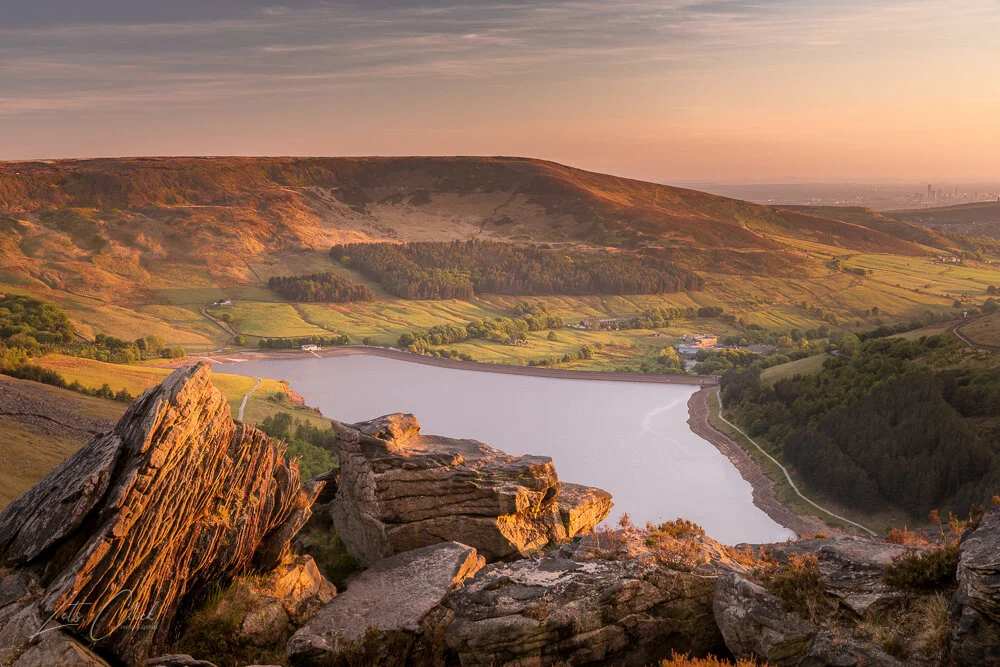
Dovestone Reservoir in the Peak District, Greater Manchester during Golden Hour - the warmth in the image down to the time of day
It’s summer in the UK - hooray!! We can finally leave the house without our rain jacket, well on some days at least. The temperature is up, the natural world is buzzing with activity, the nights are short and the days are long. What a great time to be a landscape photographer. And it is…..well kinda!
You see, it’s that ‘the days are long’ bit, that can cause some issues for landscape photographers.
During the summer months, the earth has us tilted closer to the sun and because of this our star hangs higher in the sky, leading to the longer daylight hours and warmer temperatures. But it is exactly this that poses landscape photographers challenges.
How so? You may ask. Surely, with photography being the capturing of light, longer days and more light means it should be easier to get great photos?
Well in theory, it sounds great, but not all light is the right light.
In landscape photography there are many different types of light which affect your photographs in many different ways. Flat Light, Direct Light, Blue Light, Golden Light, Diffuse Light….these are just some of the terms most landscape photographers know well. All will affect the landscape, and therefor your photograph, in different ways. Affecting colours, tones, saturation, contrast, as well as shadow length, depth, and position.

Direct Light - Whilst the day was somewhat overcast, the light high in the sky still created harsh contrasty shadows in this image. A later or earlier time of the day would have allowed the light to fall off more gradually
Unlike other types of photography, where you maintain some control over your light by utilising flash, reflectors or movement of your subject; landscape photography relies on one light source….that big ball of fire in the sky.
And when it is summer, it sits higher and longer in the sky. And there are fewer clouds. Whilst this makes for great sunbathing weather (sunscreen protection applied of course!), it can be a bad mix for landscape photographers. With the sun high in the sky casting harsh, direct light down, a level of cloud cover would provide diffusion which is a very handy way to take some of the harshness out of the suns rays.
Want to see for yourself? Grab a torch, the one on your phone will do, and shine it onto a surface in shadow. Now grab a piece of tissue and place it a couple of centimetres in front of you torch, shining the light through it. The torch still lights the surface but it’s…..well….less direct. It’s diffuse.
So how do we get around this? Well, there are certain types of shots that will lend themselves to direct light. Reflection shots being one of the first to mind. A high sun in the sky can create superb reflections in water. Taking a shot which uses the shadows to your advantage is another option; being aware of where a shadow falls may lend itself to becoming a leading line or natural frame to your subject.
There are also different ways in which to take a shot. Bracketing (or HDR as it is sometimes referred) is a method of photography whereby three + images are taken of the same composition, usually on a tripod, and then blended together. This technique ensures the range of light captured, from deep shadow to bright sky, is at a maximum, however this technique can very easily be done badly and lead to a final image that does not look real, subtilty when using this technique is a must. Using filters, adjusting settings and manipulating white balance are also useful to produce more usable images during the peak daylight hours.
But mostly, patience; patience is the key.

Lytham Windmill at dawn - the rising sun helping to create the ‘sky on fire’ look that only dawn will really gift you.
Waiting for the right light to fall upon you scene takes patience…..and time. But you can save time and get better odds of good light by going to shoot at the right time. Photographers will often refer to a time frame called Golden Hour. This is the hour or so right after sunrise, or right before sunset. It is a time when the sun is low on the horizon and light rays, specifically blue rays, are scattered coming through the earths atmosphere. This is what often gives the sun it’s orange or reddish tinge at sunset and it is the natural reason why everything looks warmer during that time. And whilst shadows become longer, they are less ‘contrasty’ right before sunset. As the name suggests, it doesn’t last long, on many days even less than an hour, but that is the light landscape photographers crave.
And so that is when photographers head out - for sunrise or sunset. And for me, in the summer, it is mostly for sunset….I enjoy my sleep!…the idea of getting up for a 4am sunrise doesn’t always appeal to me. But if that is the right time to get the shot, then that is the time I will head out.
And, like many of my photography peers on their way to location, when I set off in the middle of the night, or during late afternoon, I’m hoping for many things. For the weather elements to come together, to be able to find a composition, for there to be nothing in the way of the shot…..But most of all there is one big hope…..
Let there be light
Dave
July 2020
Whatever The Weather
…..Throughout the journey there the conditions looked perfectly set for such a shot. Wave clouds were high in the sky, the horizon was hazy but clear of low cloud formations and it was fairly still. We hit a bit of a delay as a coach had come off the road near Devoke Water and whilst waiting to get moving again, a weather front moved in from the west coast. Upon arriving at Wastwater, the sky had completely covered……
As much as photography is my hobby, it is also my full time job, through which I cover many genres of both photography and film. I thoroughly enjoy my work and all of the shoots I get to do, but there’s no doubt that my landscape photography days sit as the highlight of my working week.
Quite early on, after making the move from my corporate career to full time photographer, I decided that I would incorporate a day each week to be designated my ‘Landscape’ day. It isn’t a specific day. It is determined by the way my bookings fall. But 1 of 5 days is always left free.
Having the freedom to do that is absolutely magnificent, but has one downside. Because my landscape day is usually set weeks in advance due to the bookings in the diary, it is never planned around the weather. Whether glorious sunshine; grey and windy; or full blown storm; that is the day I will go out to shoot in the landscape, and I do, whatever the weather.

Wastwater, Lake District National Park, UK. I bet the sunset was beautiful behind those clouds
But, as I talked about in last weeks blog, the weather is your friend. It can give you that beautiful awe inspiring sunrise or pelt you with hail, but it will always be unique to that moment. It offers a challenge and changes the way in which a scene will look, and can completely change how it might be captured for a photograph.
Take the above shot of Wastwater as an example. I had ventured there hoping to capture the sunset with an idea of a long exposure shot, enhancing the glorious colours of the suns rays filtering through the earths atmosphere. Hoping for great reflections in the still, mirror like water.
Throughout the journey there the conditions looked perfectly set for such a shot. Wave clouds were high in the sky, the horizon was hazy but clear of low cloud formations and it was fairly still. We hit a bit of a delay as a coach had come off the road near Devoke Water and whilst waiting to get moving again, a weather front moved in from the west coast. Upon arriving at Wastwater, the sky had completely covered with low cloud. the shot which I had planned from the southern end of the water was now pointless. The cloud would cover most of the water up to the peaks. A change of plan and a drive north, up the western edge, to around half way up the water found a slightly clearer view and the moody image you see above was born. A polariser helped cut through the remaining haze above the water, the square crop reflected how I felt under the grey sky; a little hemmed in.
The weather forecast the evening before had predicted that this would happen, but I was hoping that it may hit a little later, forecast are never truly accurate until a short while beforehand. However, even though the weather did go that way, I’m still pleased with the shot. It tells a story. And each time I look at it I’m reminded that whatever the weather, it is always worth going out to shoot.

Another Place in Crosby on a very overcast dull day
The two photographs (above and below) of Anthony Gormley’s Another Place in Crosby, Merseyside, show another example of just how different a shot might be dependant on the weather. In the first shot, taken at sunset in October, 2019. The weather was grey and cloudy with only hints of sunlight breaking through the clouds for brief moments. The sun wasn’t visible and it had been raining on and off throughout the afternoon. A long exposure became the order of the day as there was little detail in the sky. In May 2020, the shot became something else entirely as this time the sky was hazy with infrequent clouds, the sun setting right behind the scene into which I was shooting. No long exposure here, I would not have wanted to have the sun become a blurred line down to the horizon. The feel of the two shots is very different.

The same scene (albeit a slightly different composition and exposure) with a hazy sunset months later
Whatever the weather, there is always something to shoot, there is always a way to capture that moment in time. But it will certainly help if you have the right equipment for the weather. And I’m not talking camera gear or lenses etc. Comfort in terrible weather will play a huge part in your time in the landscape. I have been caught in some awful weather, and early on in my landscape photography journey, I did not have the right footwear, clothing, bags or jacket. I was cold, wet and miserable and the majority of the time completely unmotivated to even contemplate taking my camera out of the bag.
Investing, even a little, into outerwear and footwear has helped me out no end. You still end up wet, cold and miserable….but it takes a lot longer to get to that point.
And so, my ‘Landscape Day’ is a day on which I head out regardless, each week, ready to take on the Landscape and all of its challenges…...
Whatever The Weather
Dave
June, 2020

If you can get through the rain, you might just spot the rainbow
Revisiting a location - Marys Shell, Lancashire
This is always a popular part of the coast for photographers, who come from miles around to capture their take of the fabled shell. But most of those photographers aren’t aware that they are being watched from beneath the ocean by the Ogre. You see; Mary’s Shell is magical, and it has a story to tell…….
This was my second visit in 9 months to photograph Mary’s Shell in Cleveleys, Lancashire, UK. Revisiting locations is something that I have made a conscious effort to do in these weeks following the relaxation of lockdown measures within the English borders. Familiarity with a place means that I am more than knowledgeable in what I require to take, not just photography gear wise, but footwear, type of clothing, safety equipment and of course food. Unnecessarily having to visit a shop 60 miles from home is not part of the plan in our socially distanced way of life.
It seems like the natural first steps back out in our new way of life world.
Plus, of course, all of the photographic reasons to venture back to this lovely part of the world. The last time I was here was a wet overcast Autumn afternoon, grabbing shots in between the rain clouds. And whilst I was really pleased with the shots I got on that day; this time, I was looking forward to the sun

A shot from Autumn 2019 during a short respite from the rain
Upon arrival, I wasn’t surprised to see that a fair few of my peers had also decided to pay a visit. This is always a popular part of the coast for photographers, who come from miles around to capture their take of the fabled shell. But most of those photographers aren’t aware that they are being watched from beneath the ocean by the Ogre. You see; Mary’s Shell is magical, and it has a story to tell…….

The Ogre keeping watch from afar
It’s story starts in Singleton Thorpe, which was a village off the coast of Cleveleys in the mid 1500’s. Swallowed by a tsunami in 1554/55, only three people survived and they went on to become founders of the village now known as Singleton in Fylde, near Blackpool....or so folklore says.
And that folklore is responsible for inspiring ‘The Sea Swallows’ tale, a short story based on that sunken village. In the story, the heroine is Mary, who attempts to save the village from a Sea Ogre....armed only with her magical golden shell.
And so the Ogre sits there, looking on and getting swallowed by the ocean twice a day, whilst Marys Shell commands the swell to stop.
The short story is inscribed on the inside of the shell. Worthy of a read if ever in this part of the world at low tide. And when you have finished reading, take a look over to the far left of the shell towards Blackpool Tower and there you might just see a rather rotund rock glaring at you……or is it an ogre.

The Sun and The Shell. Cleveleys, Lancashire. June 2020
There are many, many shots of Mary’s Shell on the mirror like sea and I wanted to take at least one with the sea in flow. When lining up this shot I was a bit worried that the pebbles could become somewhat of a barrier in the image, putting the Shell at bay, rather than drawing the viewer into the scene. However the sky came to the rescue, providing a lovely wisp in towards the shell, perhaps it had worked its magic again? However, that magic didn’t come for free. As I removed a soft graduated filter from the front of my camera, the unthinkable happened and I dropped it front first onto the jagged pebbles. The price of photography I suppose.

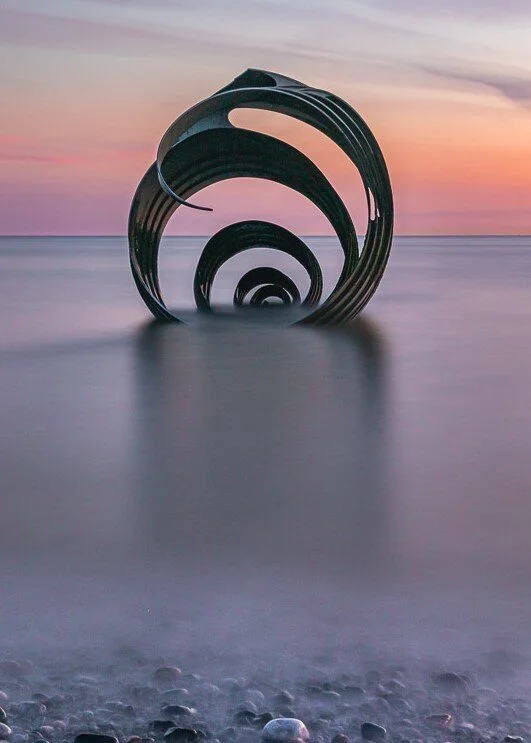
The lovely colours of a spring sunset on the North West coast
There was no doubt though that I wanted to grab a long exposure and really flatten that, now reducing, tide. This would allow for a mirror like effect, twinned with the beauty of the final farewell of sunlight from the day. The big stopper came out. A 10 stop filter came out of the bag and, very carefully, was attached to the front of the lens. This would allow my exposure time to increase to 5 seconds, enough to flatten out that fast moving outward tide. But that wouldn’t be enough to create the image that I really wanted. A multiple exposure would be needed. This would allow for the dying embers of sunset to be captured gloriously, whilst also capturing the side of the shell which faced into the dark of ensuing night, to be captured at a long enough exposure to capture the details hidden in the shadow. Referred to as High-Dynamic-Range Imaging, this meant that the exposure time of 5 seconds would need to be both decreased and increased in order to capture all of the detail. Three separate shots of 1, 5 and 30 seconds were merged to create the final image seen below. Exactly the image I wanted.
Dave, June 2020
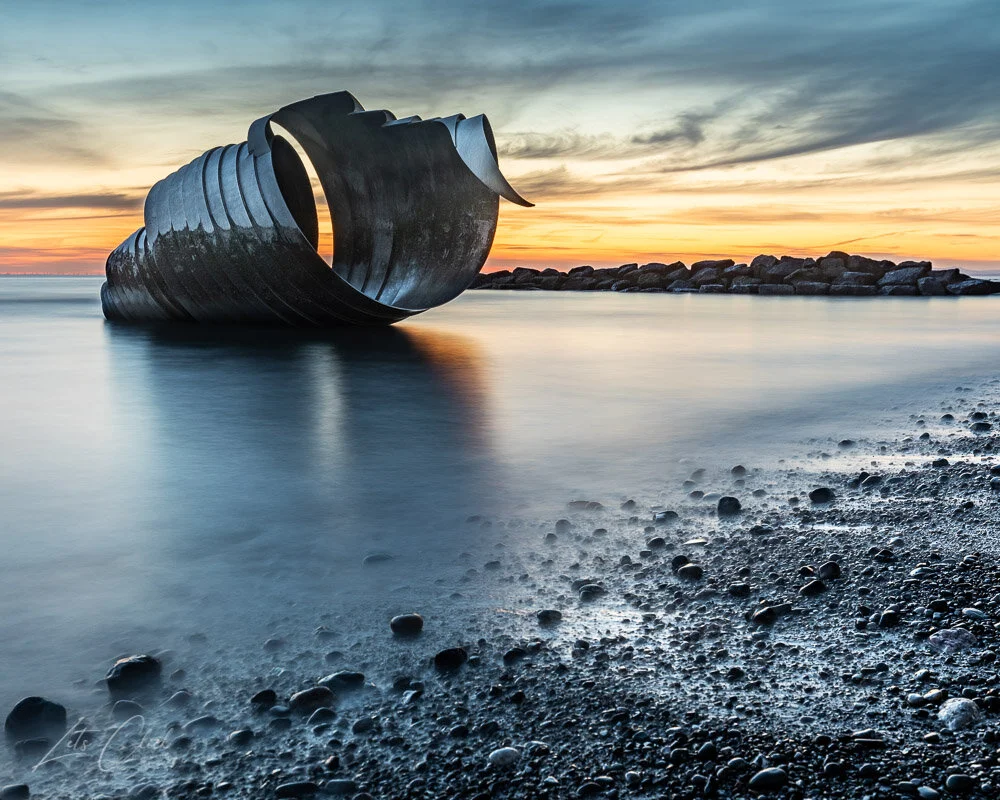
The image I wanted required a bit of time and thought but was well worth it